


VAV Case Study: BIAD Future Building Innovation Center
- RoyalService

- 11 minutes ago
- 4 min read
1.Project Profile
Project Name:BIAD Future Building Innovation Center (New Headquarters of Beijing Institute of Architectural Design)
Project Location:Beijing
Project Scale:Total Gross Floor Area (GFA) of 39,300㎡ (7 Stories Above Ground, 3 Stories Underground)
Spatial Functions:Offices, Commercial Spaces, Exhibition Halls, Conference Facilities, and Supporting Multi-Function Halls, Laboratories, and IT Equipment Rooms
Green Building Standards:LEED Gold, WELL Platinum
Product Series:Royal Service Air Conditioning Smart Variable Air Diffuser (SVAD), VAV BOX, Constant Air Volume Controller (CAVC), and Pressure Independent Module (PIM)

2.Driving a Near-60% Reduction in Annual Energy Consumption via VAV Terminals
By integrating next-generation technologies—such as high-efficiency HVAC systems, integrated solar power, PEDF solutions, and an intelligent energy-carbon management platform—the BIAD Future Building Innovation Center sets a new standard. Its annual energy use has been slashed to 25.66 kWh/㎡, while carbon emission intensity is kept at a mere 20.06 kg CO₂/㎡. This represents a massive 58.9% reduction in carbon emissions, allowing the project to directly rival top-tier European benchmarks.
With HVAC systems consuming 40% to 60% of a building's total energy, lacking intelligent terminal regulation means even the most efficient chillers and distribution networks will waste energy at part load. As the 'last mile' of building energy efficiency, these terminals are exactly where we focused our technology to guarantee maximum savings for this project.

3.The Technical Synergy: Rethinking Pressure-Dependent vs. Pressure-Independent Controls
When it comes to VAV systems, engineers usually choose between two traditional control mindsets:
● Pressure-Dependent Control: The controller speaks directly to the valve position. Because it requires very little static pressure to operate, it does wonders for slashing fan energy use while delivering a wide, ultra-fine-tuning range. The catch? Fluctuations in the ductwork pressure can easily throw off the actual supply airflow.
● Pressure-Independent Control: This setup uses an onboard airflow sensor to create a smart, closed-loop system. The controller sets a target volume, and the valve adjusts itself based on live feedback. By neutralizing duct pressure shifts, it marks a massive leap "from passive response to proactive regulation."
For the BIAD project, We moved past the "one-size-fits-all" approach. Instead, we blended the best of both worlds to deliver three highly customized terminal solutions based on real spatial dynamics.

4.Tailored to the Space: How Three Terminal Solutions Deliver Perfection
1.Private Offices: The SVAD + PIM Synergy
Where It’s Used: Private executive offices, independent boardrooms, and advanced ergonomics labs.
The Challenge: Erratic schedules, unpredictable crowd sizes, and zero tolerance for background noise or cluttered ceilings that disrupt architectural aesthetics.
Our Solutions: We eliminated standard air vents and deployed the Smart Variable Air Diffuser (SVAD). It redefines low-energy design by running on a mere 10–70 Pa of static pressure. Powered by built-in AI chips, thermal sensors, and ultra-quiet actuators, it allows users to control their own microclimate via touchpads, apps, or remotes. It’s not just a product; it’s a personalized space strategy.
Engineering Brilliance: Traditional variable diffusers can experience airflow drift when duct pressure changes. To lock in total stability, we paired each SVAD with a smart PIM. The PIM acts as an automated buffer, smoothing out pressure spikes so the SVAD always delivers the exact volume of air requested.
The Bottom Line: This configuration blends the best of both worlds—giving designers the ultra-fine control and low-pressure energy savings of an advanced diffuser, backed by the rock-solid stability of a pressure-independent system. This integration delivers a verified 25% to 30% reduction in terminal energy consumption while uncompromising on indoor comfort.


This groundbreaking system has caught the attention of academia and is now a core data-harvesting platform for Tsinghua University’s milestone study on human-centric public building environments. By tracking how flexible, gentle airflow boosts workplace focus and well-being, our technology is actively helping write the future playbook for human-first architectural design.
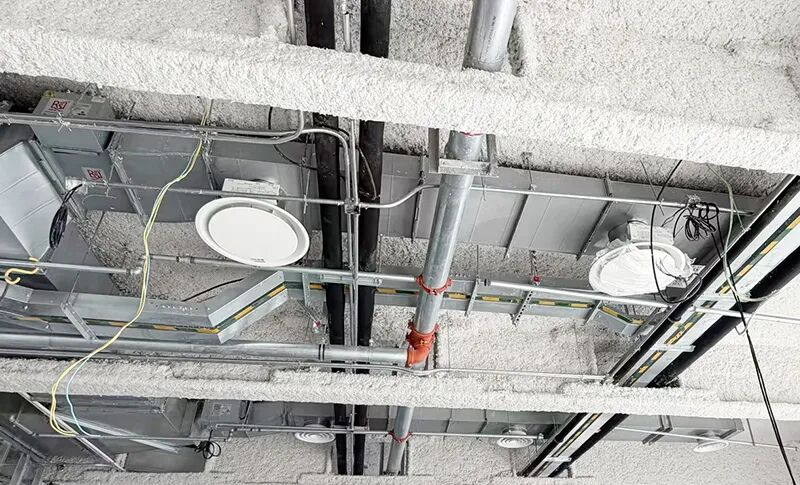
2.Interior Office Zones: The Pressure Independent VAV BOX
Where It’s Used: Open-plan interior office zones across Floors 2 to 6.
The Challenge: Deep architectural footprints, high-density seating, and constant, stubborn internal heat loads. These large spaces demand a terminal system with lightning-fast response times and unflinching airflow stability.
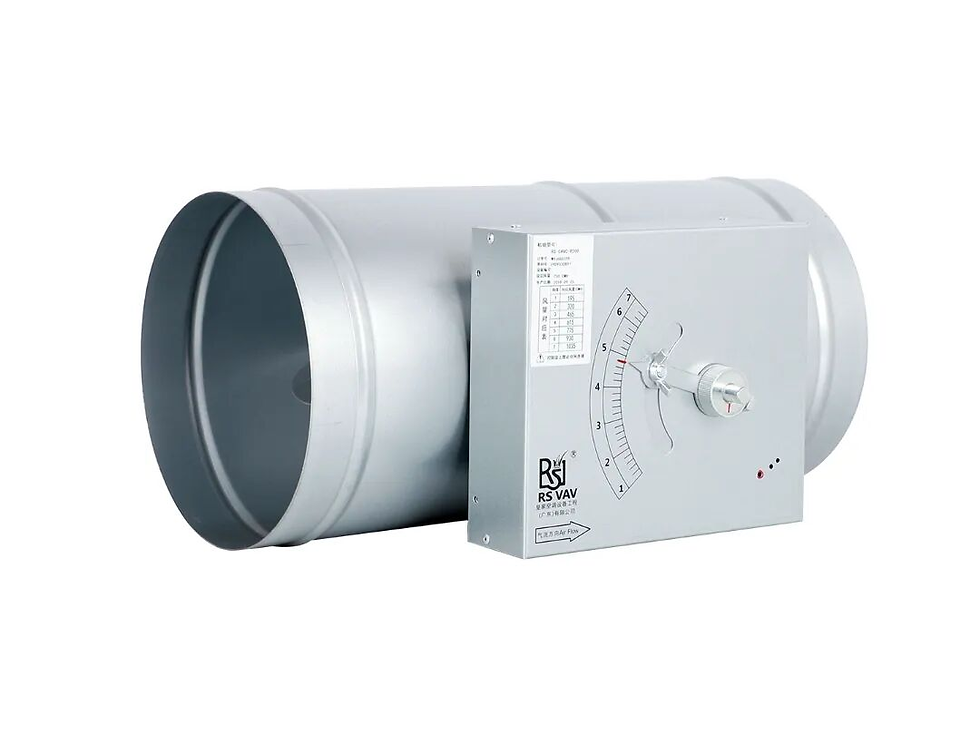
Our Solutions: We deployed RS Pressure-Independent Single-Duct VAV BOX. Featuring an onboard Pitot-tube velocity sensor, the unit continuously monitors primary airflow and runs on a smart, closed-loop control cycle. Real-world testing proves its resilience: even when main duct pressure spikes or drops by up to 30%, terminal airflow deviation is kept within a razor-thin ±5%. This guarantees a perfectly stable, draft-free microclimate across expansive open offices.


3.Dedicated Outdoor Air Systems (DOAS): The Mechanical CAVC
Where It’s Used: Fresh air supply ductwork.
The Challenge: Fresh air systems require absolute volumetric constancy 24/7 to maintain indoor air quality, yet they are almost always relegated to cramped, restrictive installation shafts.
Our Solutions: We selected our purely mechanical, self-adaptive Constant Air Volume Controller (CAVC). Powered by an ingenious self-balancing spring and silhouette bladder mechanism, the CAVC automatically locks in the pre-set airflow volume across a wide differential pressure range of 50 to 1,000 Pa.
The Bottom Line: With zero electrical wiring required, its ultra-streamlined design drives the failure rate down to practically zero. Supporting both horizontal and vertical installation, it fits seamlessly into tight riser shafts, making it the ultimate "set-and-forget" solution for heavy-duty fresh air management.

5.Conclusion & Key Takeaways
The BIAD Future Building Innovation Center successfully demonstrates a sophisticated equilibrium where occupant well-being, architectural minimalism, and rigorous carbon reduction coexist without compromise. By executing a meticulous alignment between top-level green philosophy and Royal Service Air Conditioning's high-precision terminal systems, the project serves as a premier reference case for future-proof commercial engineering. Optimizing every cubic meter of airflow for maximum efficiency is the fundamental engineering baseline that transforms aggressive carbon neutrality goals into a verifiable, operational reality.

![Royal Service Empowers Global Partners with Hands-On Training at Premier Automation Facility [Guangzhou , GD]](https://static.wixstatic.com/media/f2c9cf_06959714b2b141a9b742a260fd3b6a7e~mv2.png/v1/fill/w_800,h_533,al_c,q_90,enc_avif,quality_auto/f2c9cf_06959714b2b141a9b742a260fd3b6a7e~mv2.png)
Comments